


Click here for the full report
The 2025 edition of the Rio Open presented by Claro reinforced the tournament’s commitment to sustainability by expanding the results of its environmental program, Rio Open Green, which is now firmly established as a strategic pillar of the event. This year, the tournament offset 1,819 metric tons of carbon dioxide equivalent (tCO₂e), recycled, reused, or composted 69.2% of the waste generated, and boosted the local economy with an estimated financial impact of R$ 200 million.“The 2025 edition demonstrates the maturity of the Rio Open’s sustainability strategy. The figures prove that it is possible to host a major sporting event with an increasingly lower environmental impact while simultaneously generating significant economic results for the city and the community. Our focus remains on continuous improvement year after year, engaging fans and the entire event supply chain in this journey,” said Marcia Casz, General-Director of the Rio Open.
In partnership with ENGIE, Rio Open 2025 fully offset the greenhouse gas emissions associated with both event operations and spectator travel, a pioneering initiative in Brazil. Of the total emissions offset, 470.26 tCO₂e came from operational activities and 1,348.62 tCO₂e from spectator transportation, which accounted for approximately 74% of total emissions. All emissions were audited by an independent third party and offset through carbon credits generated from renewable energy production at the Jirau Hydroelectric Power Plant, registered under the United Nations Clean Development Mechanism. The project’s shareholders are ENGIE (40%), Axia (40%), and Mitsui (20%).
“This collaboration has delivered significant results and should be regarded as a benchmark to encourage the sports industry to adopt practices that accelerate the transition to a carbon-neutral economy. Our purpose is to foster a cultural shift that embeds sustainability across all spheres of society and to support major events in developing more robust and effective policies and guidelines. This joint effort demonstrates that sport, entertainment, and social and environmental responsibility can go hand in hand, creating high-impact experiences with a smaller environmental footprint,” said Eduardo Sattamini, CEO of ENGIE Brasil.
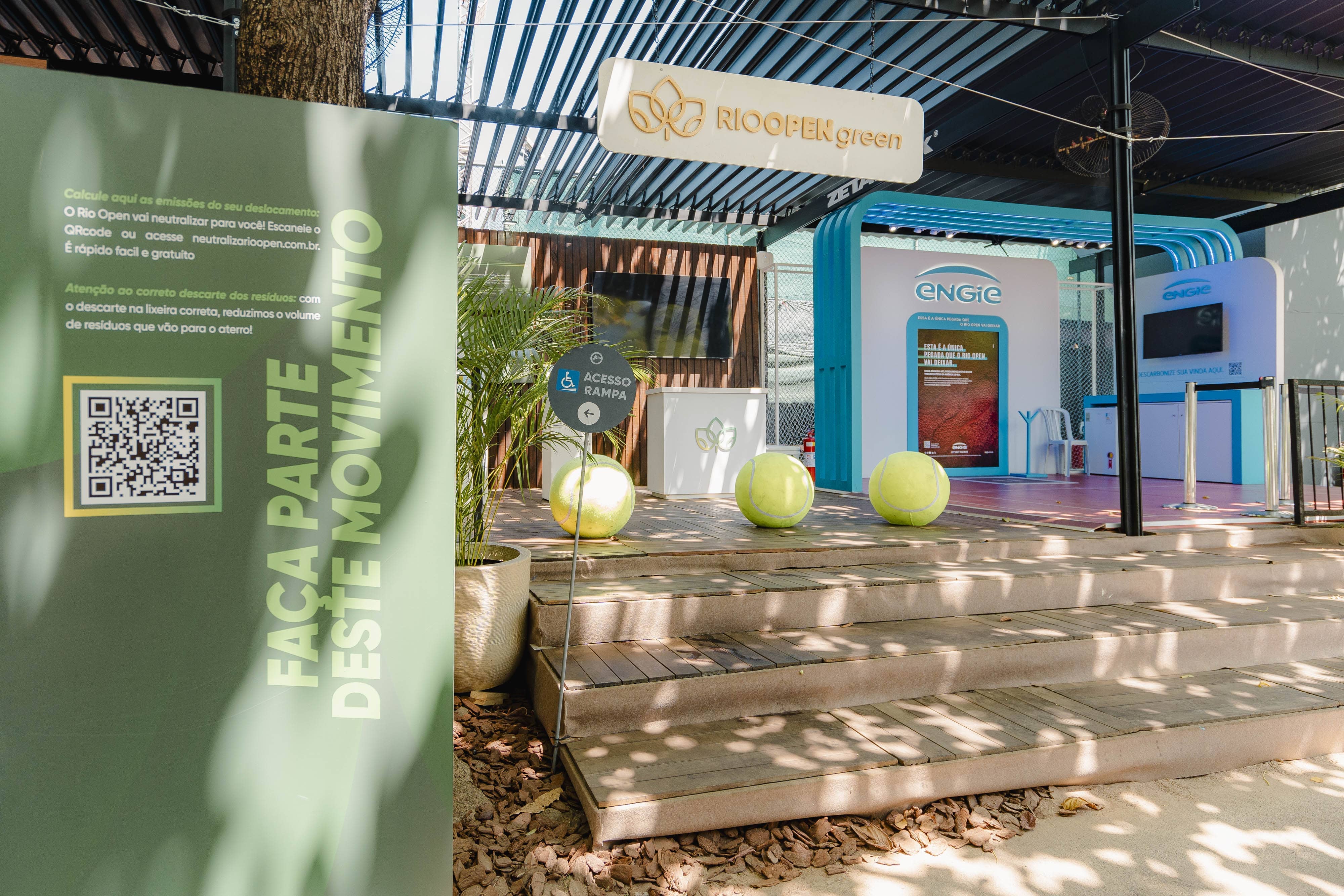
The 2025 edition also expanded the role of spectators in the tournament’s decarbonization strategy. Around 40% of the audience—out of the 69,000 attendees—came from other states, in addition to the participation of 73 international athletes, underscoring the importance of the interactive carbon calculator available from the moment tickets were purchased. The tool allowed spectators to declare their mode of transportation and understand their carbon footprint, including zero-impact travel options such as bicycles and public transportation. During the event, the Rio Open Green booth served as a hub for on-site engagement, awareness, and decarbonization initiatives.
Waste management advances in 2025
Another highlight of the 2025 edition was the progress made in solid waste management. This year, the Rio Open generated 48.2 metric tons of waste, of which 69.2% was recycled, composted, or reused. Only 30.8% was sent to landfill sites, which are equipped with methane recovery systems, effectively reducing emissions from this category to near zero.
Among the initiatives implemented or expanded this year were the reduction of single-use disposable plastics—particularly among food and beverage vendors—clearer visual communication to guide proper waste disposal by spectators, the reuse of materials such as rackets, balls, clay, and tarpaulins, and the composting of organic waste, thereby closing the loop in sustainable waste management.
Sustainability with economic and social impact
Beyond environmental advances, Rio Open 2025 reaffirmed its role as a driver of sustainable economic growth. Through the Rio Open Community pillar, the tournament generated an estimated financial impact of R$ 200 million, boosting tourism, gastronomy, local consumption, and the creation of direct and indirect jobs.
The 2025 edition also reinforced the prioritization of local suppliers and partnerships with companies aligned with environmentally responsible practices, further expanding the event’s positive effects on the regional economy and the community.
Engagement as a defining feature of the edition
Audience engagement was one of the standout features of the 2025 edition. From ticket purchase to the on-site experience, communication initiatives encouraged sustainable practices and active spectator participation, particularly in waste management and carbon offset initiatives. The result was an experience that combined elite-level sport with environmental education and the promotion of climate action.