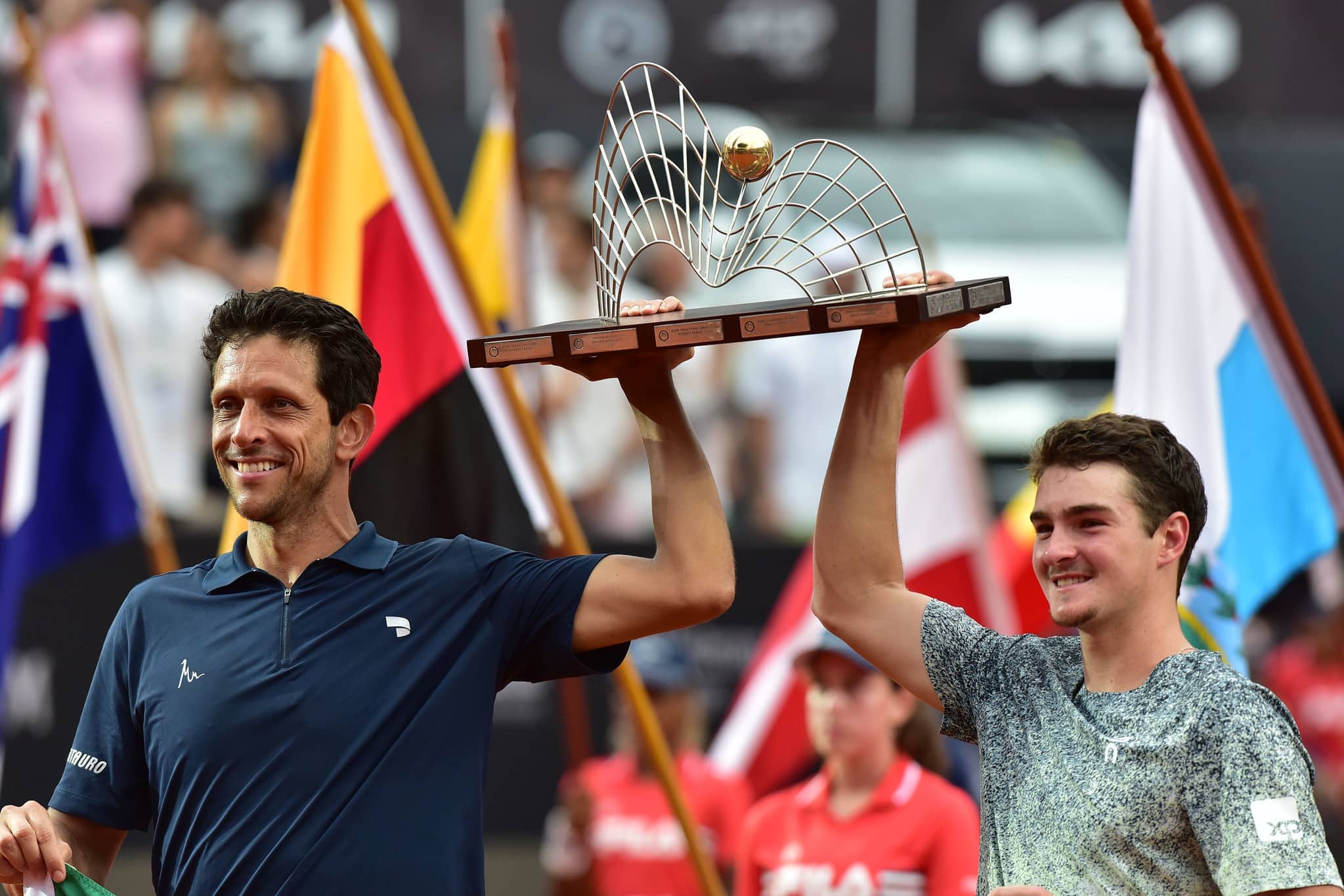



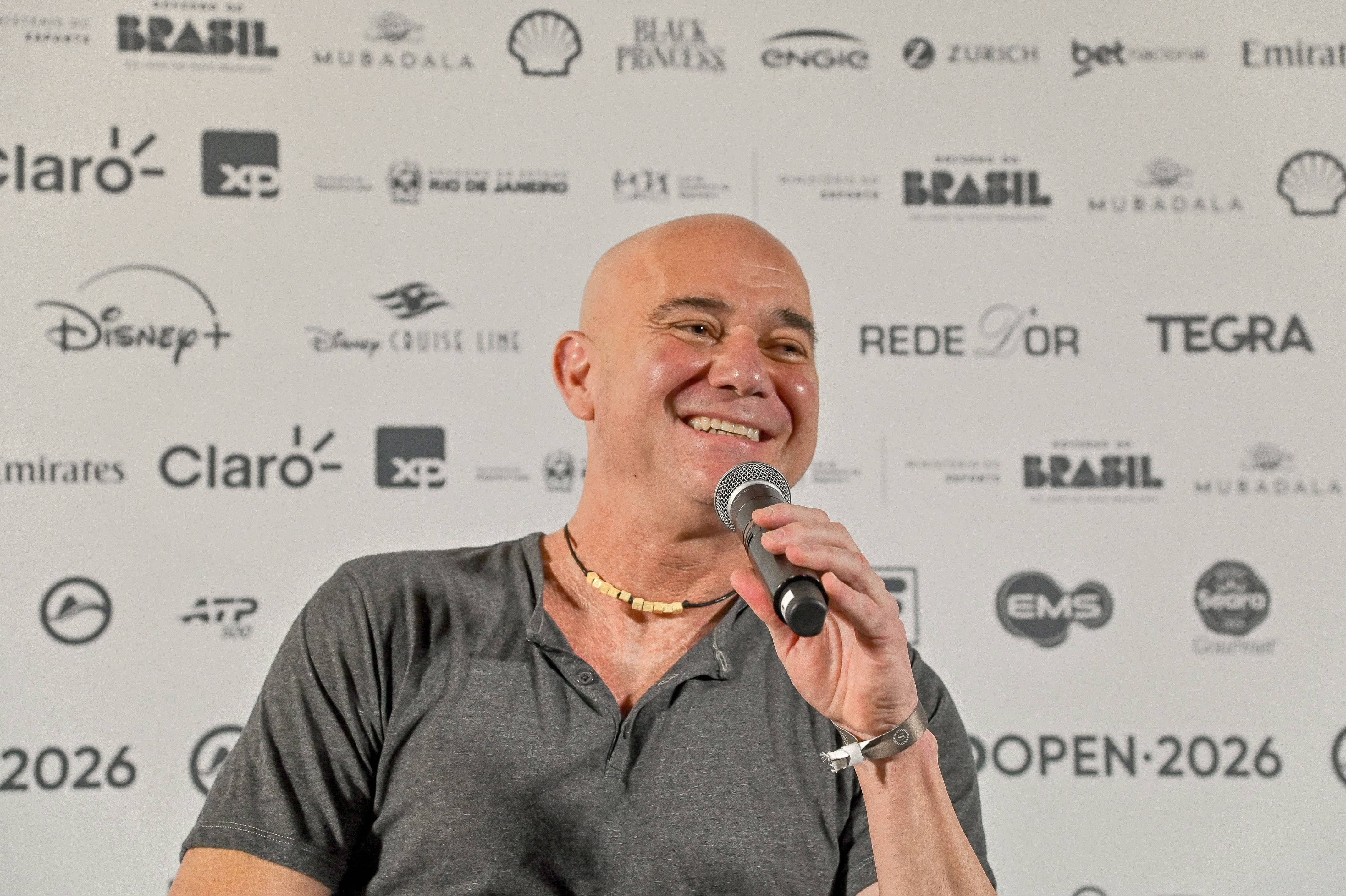
One of the biggest names in the history of tennis, former world number 1 Andre Agassi is at the Rio Open presented by Claro to award the trophy to the champion on Sunday. Before that, he met journalists this Friday in the press room. See the hole interview below.
Q: Welcome to Rio. I know you've just arrived to the Rio Open. What are your first impressions?
A: First of all, it's great to be back and have an excuse come back to Brazil. So many memories here. I've only had just a brief chance to walk through the club, which seems extraordinarily beautiful, both from a facility standpoint, but also the scenic environment. It's very intimate and I ran into João out there in the practice courts, and got to spend a week with him at the Laver Cup. So it was very nice to see him again. He is obviously quite the sensation, but even a better human being, very much beyond his years, mentally, emotionally, very self aware, very aware of his environment, very smart processes, very well. I always enjoy seeing somebody that I respect so much on and off the court.
Q: You played many times with Chilean players. Are you aware of the current Chilean players? Alejandro Tabilo, Cristian Garin?
A: I just saw him play for the first time on TV this past week. Unfortunately, my opportunity to see these players are only when they're actually playing on television. So they need to go pretty far in these events in order to make it to my living room. But with that being said, doesn't take me much to process their game and love watching the tradition continue of great players from Chile.
Q: Have you ever thought about a Laver Cup edition in Brazil?
A: I wish I had more control over such decisions, especially when you get to pick your team, surfaces, locations. There's a lot that goes into making an event like this happen in a calendar year with such a heavy demand on the players schedules. The location is also very important that it stays in flow of their access to the next tournament. There's a lot of considerations. The Laver Cup has done a great job in figuring out, the working logistics to make it as successful as possible, but I mean to play here and with that format, with that event, would be remarkable. This is a very passionate sports country and I've always seen it firsthand. The Brazilians coming out to cheer their favorites and I playing down here having my first win in Brazil in 1987, I've learned firsthand just what kind of passion and environment Brazil can bring to any sporting event, let alone such a great one, with the Laver Cup. It's a very intense weekend of tennis, and I've met many fans who have been to many Grand Slams and they've been to the Laver Cup and you'd be surprised how many of them would choose the Laver Cup if they only had one choice, because of just how intense that weekend can be and the uniqueness of seeing so many different styles of matchups, from devils to playing with your peers, the guys show up with such intensity when, when it's when it's time to play. So, having it here would be amazing. But unfortunately, I don't have the decision to determine this with us.
Q: You shared the Laver Cup with Francisco Cerundulo. Do you think he has the conditions to enter the top 10?
A: The Cisco Kid. That's like I call him. He's awesome. He's, he was, he's been a rock for the Laver Cup World Team. I mean, he's one of the toughest outs in tennis. He always shows up, work ethic, just great mover. How powerful forehand, great competitor. I never count out anybody from accomplishing what they're capable of, or even more, because so much of that happens in the mind, more than what the skills are. He has the skills to do this and I think he has a work ethic to do it. I love being around him. I love watching him play and I think he's getting better. So, I never count somebody out. I would always take hard work over incredible talent. I've seen incredible talent get wasted. I've never seen hard work not impress people on what they're capable.
Q: You had a great experience working with Laver Cup and you had a brief experience working with Grigor Dimitrov few years ago. Do you plan coming back to work full time with any player?
A: Well, I don't think I've ever really worked full time with any player. That's requires a lot of travel, a lot of time. What I don't have bandwidth for. You know, I've known Grigor since he's been a teenager. He's come to Las Vegas many times to see me, he's just a beautiful person and always wanted to see the most for him and I was able to work more often with him for a period of maybe a year and a half or so and I think we both were better for the time spent. You know, he added a lot to my life as well. And I don't see me ever really traveling as a full time coach, if that's what you mean. It would take a real special set of circunstancies for me to, you know, just logistically and practically and with the things I have as priorities now, but in a lot of ways, I feel like you can make the most difference almost with the distance, hopefully being a North Star for somebody to hear something objectively, right? It's never what you say that's important. It's what somebody hears. And I think sometimes when you're with somebody all the time, it can get muddied, it can get unclear. It can get, but from a distance. You can say: “ Hey, this is what I'm noticing. How do you feel? Because this is what I'm seeing”. I like this and it kind of helps the players stay a little bit clearer for themselves. So I would argue that sometimes I can be more effective from a bit of a distance, but time spent is always important.
Q: What is the most difficult part of playing home with the crowd? It can be a boost of confidence, but it's tough. What can you say about it?
A: It's a very individual, personal reaction that players have. Some players go very inward. If they're playing in a competitive environment, they're playing against somebody in a home crowd, sometimes this can bring out the best of somebody, depending on how they're wired, right? I mean, we've seen it for so many years with no back, it's almost as if he encourages a very aggressive environment against him at times, to bring out the best in him and then we see other times where the energy of the home crowd can lift somebody so high. But then I can also bring some some pressure, you know? So I think the stakes are always high at home. And I think it's a sensitive emotional reaction, and I think it's very individually, unique to how somebody handles it. It's every person can treat that a little differently. I mean me personally, it was always 50/50, you know? Sometimes that home crowd gave me everything I needed and other times I wanted so much to do it for them. I wanted it too much and it almost made it harder at times. So I was always a player that went back and forth with if it was going to be good, if it's not going to be good. I always appreciated it, but sometimes it would backfire.
Q: Which is the most important difference that you find between the time where you were a tennis player and this moment?
A: There's a big difference. Sure, the game's always improving. The game's always changing. You know, the first major change came, I think, in the game, not the first, but the one that really seemed to shift the strategy, the geometry of tennis, was with the luxlon string. You know, when Guga brought this in, you know the spin right when you can, when you get rewarded for for swinging faster and having more control, it starts changing trajectories, and it starts changing geometries, and then it starts changing court position, and so it starts changing everything. Then the child that's growing up seeing this, they start succeeding, more or less spending how big they are, how far back they play, to give themselves the time. So eventually it's a slow pendulum, but the game always has to adapt and has to get better, you know. So, you know, I was fortunate enough to play the game in a way that allowed me to take on, in my time, the people coming forward, and then it allowed me to take on the people that played a long ways back, because I always played in between the two and so I could take people's time this way, wherever they played, but these days, the athletes are much bigger, much faster and there's much more transition tennis in the game. You never quite know when you're ahead in the point, because from any part of the court, these athletes can hurt you. So it has changed dramatically. There's still a lot of strategy involved, but it's just different rules of engagement.
Q: What do you can tell to those people who are expecting João Fonseca to win every single match?
A: First of all, I would encourage João to take that as a big compliment. You know that people think he should win every match. it's a big compliment. I would also encourage him not to realize that him living up to other people's expectations is not his responsibility. He is always seeking to improve his responsibility. So I would hope that he has, let's say, comfort in this separation of other people's expectation versus what he chooses to do and focus on for himself. And sometimes it gets difficult, because you get ahead of yourself or you start attaching a little too much value to winning or to losing, and you forget on what you need to do to get better, because winning is a byproduct of doing 1000 things right? You know he's the luxury of being young, but he has the burden of being so much expectation. And I know him well enough to understand his sensibilities, as I mentioned, he's emotionally beyond his years, very intellectually smart, emotionally stable. You just hope for him to be shepherd in a very nuanced, focused way, because there's no reason why he shouldn't be getting better every week.
Q: What do you think about all this new talk about changing the South America swing from clay courts to hard courts? What do you think about tennis in Mideast with Doha, Dubai, South Arabia?
A: Well, I don't have a privileged seat behind the scenes for all the reasons for decisions, but what I do see is the sport has turned into big business. It's only grown. Some players are treated as corporations now. That's how much business there is to be had. So, the human condition is undefeated. If you want to know where something's headed, always follow the money. But with that being said, I have a special place in my heart for being down here for many reasons, from all the fans of sport and tennis down here in South America and I do like to see the equity of that being shared. I think changing surfaces could have an impact on certain players decisions to come down here, because this is a pretty difficult transition to go from here straight to the American hardcores, and it takes its toll on players. I think we saw last year with Zverev, who came down here, and then it was took him a while to find his footing. So I do think in some respects, the surface would encourage other players to continue it, some players have to manage your schedule. You have to manage your game and your decision making and your places you play based on making sure you are peaking at the time that you want to play your best. I don't know if it's going to answer every question, but I'm not easy to go from hardcore to the heaviness of this environment. You can feel it in the air, the humidity, the dense, denseness of the clay, this the weight, the slowness to then back to the hard courts. It's not easy on the body, not easy on the mind, not easy on the traveling. There's so many working opponents for these players to make that decision. But I do like to see the game grow. I like seeing expansions. I like seeing facilities getting better. I like seeing new countries getting involved. I like seeing competition. I like seeing the sport benefiting from all that, but to say I understand the working components as to where the downsides are. I don't sit behind the curtain on that, so it'd be hard for me to speak to the pros and cons.